Garrison, D. R., Anderson, T., & Archer, W.등이 1999년에 발표한 논문
"Critical inquiry in a text based environment: Computer conferencing in higher education."
은 당시 텍스트 기반의 온라인 학습 환경(Computer Conferencing)에서 어떻게 하면 '비판적 탐구(Critical Inquiry)'가 일어날 수 있는지를 분석했다.
이 연구는 온라인 교육이 단순히 정보를 전달하는 수준을 넘어, 어떻게 고등 교육 수준의 깊은 학습(Deep Learning)을 이끌어낼 것인가에 대한 고민을 담고 있는데, 사회적 실재감(Social presence), 인지적 실재감(Cognitive presence), 교수 실재감(Teaching presence)의 상호작용 모델을 제시하여 이 실재감으로 학습 경험을 설명했다.
탐구 공동체 모델(Community of Inquiry, CoI)은 특히 온라인이나 블렌디드 러닝 환경에서 '고등 정신 기능'을 촉진하기 위해 필요한 세 가지 핵심 요소를 정의한다.
교육은 단순히 지식을 전달하는 것을 넘어, 학습자들이 협력적으로 의미를 구성하고 비판적으로 사고하는 '공동체'를 만드는 것이 목적이 되어야 한다.
>>> 3대 핵심 실재감 (Three Presences)
이 프레임워크는 교육적 경험이 다음 세 가지 실재감이 교차하는 지점에서 발생한다고 본다.
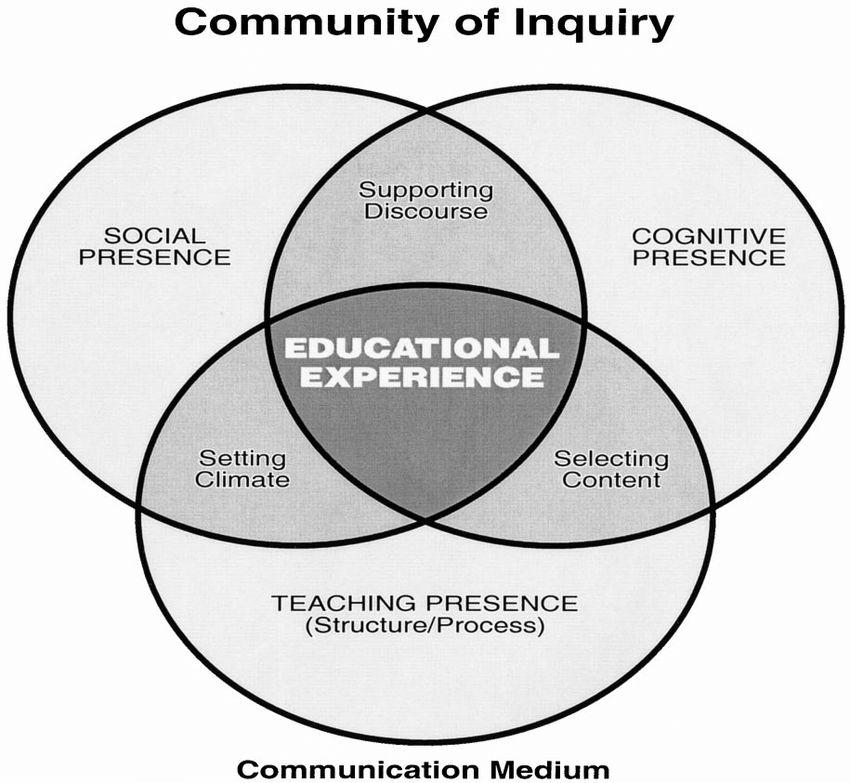
① 사회적 실재감 (Social Presence)
학습자가 공동체 안에서 자신을 심리적으로 드러내고, 다른 구성원과 인간적인 유대감을 느끼는 정도이다.
정서적 표현, 개방적 의사소통, 응집력 등이 핵심이며, 신뢰가 바탕이 되어야 비판적인 질문이나 토론이 활발해진다.
② 인지적 실재감 (Cognitive Presence)
학습자가 지속적인 의사소통과 성찰을 통해 의미를 구성하고 확인해 나가는 정도이다.
문제를 인식하고, 탐색, 통합, 해결(적용)의 과정을 거치며 실천적 탐구 과정을 통해 인지적 효능감과 성취를 느낄 수 있다. 이것은 학습자가 단순히 정보를 수용하는 수준을 넘어, 자신의 지식 체계(Repertoire)에 통합하도록 유도한다.
③ 교수 실재감 (Teaching Presence)
인지적·사회적 실재감이 유의미한 학습 결과로 이어지도록 설계하고 촉진하는 역할이다. 교사 혼자만의 몫일 필요는 없으며, 시스템이나 동료 간에도 발생할 수 있다. 교육 과정의 설계와 조직이 필요하며, 조력(Facilitating) 및 직접 교수도 활용될 수 있다. 이것은 학습의 방향성을 잡고, 토론이 산으로 가지 않게 조정하며 지적 자극을 제공한다는 의의를 갖는다.
이 모델은 특히 온라인 학습의 한계를 극복하는데 의미를 갖는다. 물리적으로 떨어져 있는 온라인 환경에서 발생하기 쉬운 '고립감'을 사회적 실재감으로 해소하도록 도울 수 있으며, 학습자들이 서로의 아이디어에 대해 '백토크(Back-talk)'를 주고받으며 논리적 허점을 찾고 보완하는 환경을 구축하게 한다. 교사의 역할 역시 지식의 전달자에서 '탐구의 촉진자'이자 '환경 설계자'로 전환된다.
이 모델을 설계에 반영한다면 다음과 같은 안이 가능하다.
1> 사회적 실재감 : 아이스브레이킹 활동, 개인적인 경험 공유, 화상 채팅에서의 즉각적인 반응.
2> 인지적 실재감 : 비구조화된 문제 던지기, 동료 피드백, 모델링 결과물 공유 및 비평.
3> 교수 실재감 : 명확한 가이드라인 제공, 핵심 개념 요약, 논의의 흐름을 짚어주는 개입.
[1] Garrison, D. & Anderson, Terry & Archer, Walter. (1999). Critical Inquiry in a Text-Based Environment: Computer Conferencing in Higher Education. The Internet and Higher Education. 2. 87-105. 10.1016/S1096-7516(00)00016-6.
(PDF) Critical Inquiry in a Text-Based Environment: Computer Conferencing in Higher Education
PDF | The purpose of this study is to provide conceptual order and a tool for the use of computer-mediated communication (CMC) and computer conferencing... | Find, read and cite all the research you need on ResearchGate
www.researchgate.net
1. Garrison, D. R., & Arbaugh, J. B. (2007). Researching the community of inquiry framework: Review, issues, and future directions. The Internet and Higher Education (이론의 발전 과정을 정리한 리뷰 논문)
https://www.researchgate.net/publication/248540829_Researching_the_community_of_inquiry_framework_Review_issues_and_future_directions
2. Anderson, T., et al. (2001). Assessing teaching presence in a computer conferencing context. Journal of Asynchronous Learning Networks. (교수 실재감을 어떻게 측정하고 설계할지 구체화한 연구)
(PDF) ASSESSING TEACHING PRESENCE IN A COMPUTER CONFERENCING CONTEXT
PDF | This paper presents a tool developed for the purpose of assessing teaching presence in online courses that make use of computer conferencing, and... | Find, read and cite all the research you need on ResearchGate
www.researchgate.net
(PDF) Researching the community of inquiry framework: Review, issues, and future directions
PDF | Since its publication in The Internet and Higher Education, Garrison, Anderson, and Archer's [Garrison, D. R., Anderson, T., & Archer, W. (2000).... | Find, read and cite all the research you need on ResearchGate
www.researchgate.net
'제삼취미 > 교육이론' 카테고리의 다른 글
| Situated Learning(Jean Lave and Etienne Wenger) (0) | 2026.03.14 |
|---|---|
| David Kolb의 경험 학습 이론(Experiential Learning Theory, ELT) (0) | 2026.03.14 |
| Aesthetic Experience in Mathematics and Education (0) | 2026.03.12 |
| Human Understanding - Toulmin (0) | 2026.03.12 |
| 우리는 인간 행동의 어떤 측면을 아름답다고 보는가? (0) | 2026.03.12 |